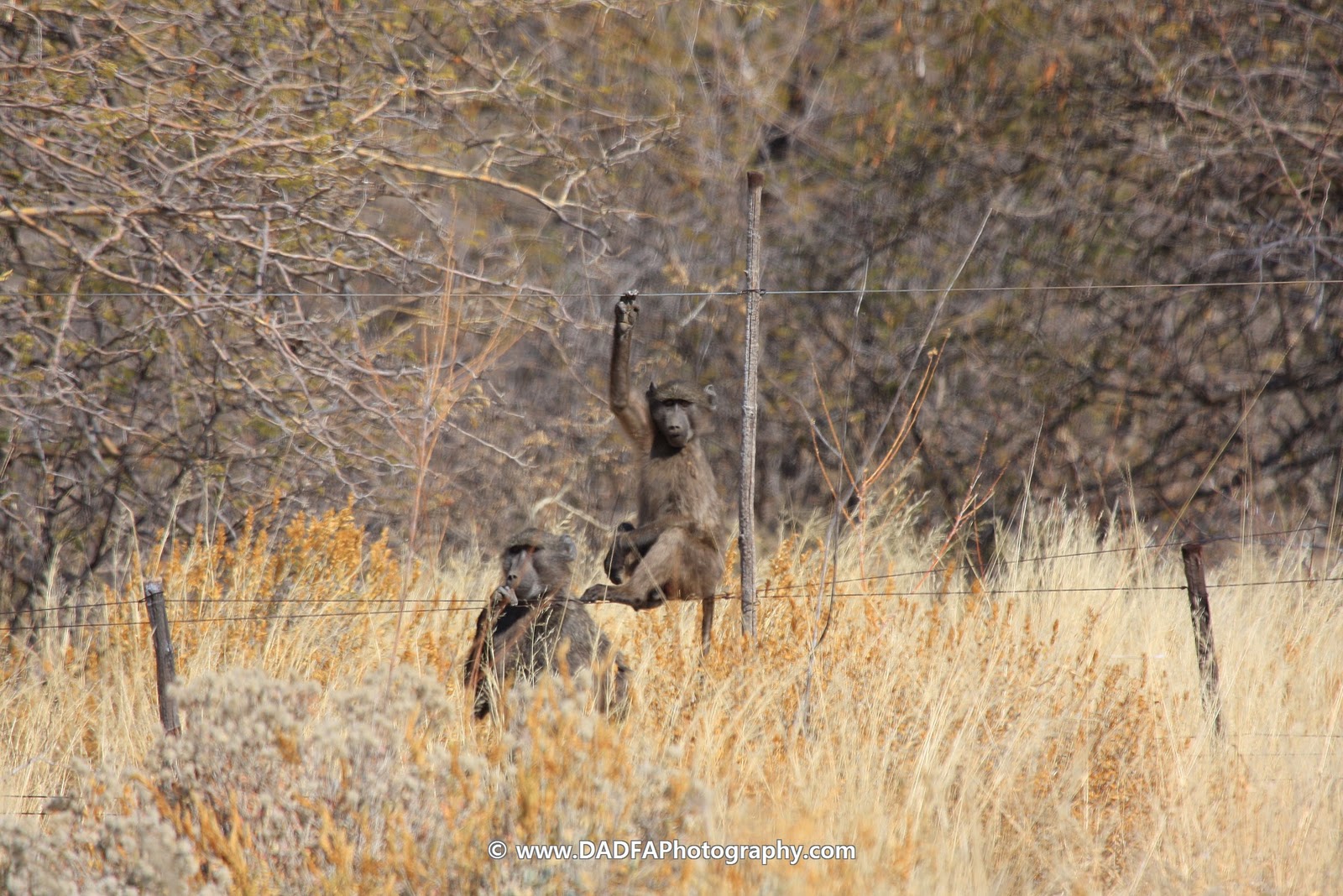
Our first lodge of this trip was Epako Lodge in Erongo about 3 hours drive north of Windhoek, a nice easy drive out from the Capital. It didn't take long before we saw some baboons, driven from the extremely dry bush to try their luck in the highway dividing strip. We hadn't driven much more than 15km from the centre of town when we encountered the first troupe busy digging up their morning meal.
This was our first trip during the summer and the difference between a trip in July and a trip in February is amazing. Even though the annual rainfall in Namibia (if you exclude the Caprivi Strip in the north of the country) is around 36cm (14.5") a year because it all falls in a short period the effects over the wet season (Jan - Mar) are amazing. The bush quite literally explodes during that short period and the whole countryside is completely different.
Our trip earlier this year was in February when the average precipitation is 8cm, fast forward to July / August and it drops to nil. Some of the shots that we took will show this, in later posts to the blog, you'll see the difference.
Epako lodge is a pretty enjoyable lodge, it's run by a very cheerful French guy and his Dutch wife. They have been there for around 15 years and in Africa for 30 or so. Get to talking with them if you go, some of the stories he can tell about working in West Africa just go to show how much "fun" that part of the world can be.
The lodge has a good variety of game and provides enough variety to keep you occupied for a 2 night stay. We managed to see a number of the more elusive creatures of the African veldt this trip and at Epako we saw the first of them, an Aardvark.
The food is pretty good too but for our tastes, the presentation and whole dining experience is a little too European for us. Something that was more noticeable to us on this trip, much more than any other, was the "cultural bias" of the lodges where we stayed. If the host was French, German or of other European extraction, the clientele was overwhelmingly from the same country, this hadn't stuck out quite so much for us in previous trips.

Epako has a family of Rhino, the female is now too old to breed but she has a calf at foot, he's a couple of years old now and just about ready to be shown the door. The first evening we were there, the male came and joined the group by the waterhole and started to become a little amorous.
You can see in the photo at the left, she wasn't too happy about the advances from the big male and tried to see him off. She had a scar along one side of her head that was the result of an earlier encounter with the male. She also has a weird large horn that bends forward rather than the normal curved rear facing normal shaped horn. Apparently, she lost her horn when she was very young when she charged a vehicle and it hasn't grown back in the normal shape.
The two of them had a protracted game of push and shove, the male weighs in at around 3500Kg, substantially larger than the female. She didn't back down too much though as you can see from the shot to the left, there was plenty of dust kicked up by the two.
As I said, things are pretty dry in Namibia at the moment and Epako was feeding out hay to the larger grazers to keep them in decent shape. They harvest the long grass by the road side and bale it up as farmers would cereal hay. There are two advantages to this, a cheap source of roughage which will at least keep the grazers fed and it reduces the potential for road side fires. There was plenty of evidence of this as we toured around, small spot fires that had been extinguished.

Like many lodges, Epako had some of the large cats in captivity, held large camps (African term for paddock) and we had the opportunity to feed these beautiful creatures and photograph them. Epako keeps a couple of Cheetah that are fed by the tourists each evening. These obviously have become used to this and can't be released.

I really have mixed feelings about these types of arrangements and even photographing the animals in these situations even if they do provide some great shots. The animals clearly cannot be released due to the increased familiarity with and dependence on humans for their food, however, if they have been trapped and then released into these enclosures it's because they have been preying on livestock and valuable game on commercial game farms.
It's not exactly conservation in the true sense but it's much better than the alternative, being seriously wounded in a snare by poachers or poorer farmers in an attempt to protect their livestock.
There is massive debate in Africa over how to protect the land, the wildlife, traditional cultures while the various countries progress. There's the argument between conservationists and preservationists as well as the farm lobby and the green movement, as there is in other countries. There is also the problem in Namibia of the death of the San Bushmen culture, with some believing that the culture will become almost extinct within the next generation or two.
Although we love the country and enjoy ourselves immensely there, there's much that as a tourist we don't get to see nor do we completely understand the problems. It is however, a country with enormous potential and there are some very innovative, forward thinking and dedicated people working towards viable solutions to the conservation issues. More on them later as we visited places on this trip dedicated to providing solutions.
Cheers
DADFAP
 Scumbag Groenwald, accused of multiple crimes related to Rhinos has had a Rhino "poached" from his Polokwane property in Limpopo, South Africa.